Everything discussed in this book must have already been discussed by someone at one time, in one context or another. We just do not yet know who it was discussed by and when.
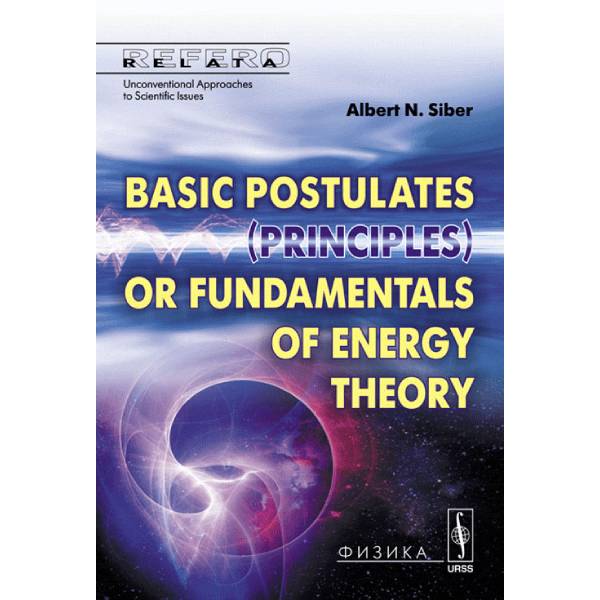
The principles (postulates) of energy theory state the following.
The Universe, in all of its parts ranging from the minimal to the maximal is constantly pulsating, compressing energy in some parts and accordingly rarefying it in others.
The Universe is to be considered in terms of three independent constituents (general coordinates): Energy, Space, and Time. The essence (main feature) of the Universe is the motion of Energy and Energy fields in Space–Time, nonexistent separately from each other. In the absence of motion, no fields exist; in the absence of fields, no motion is present. Only energy fields exist–potential, kinetic, electric, magnetic, gravitational, and all other fields. Only energy interaction exists–gravitational, electromagnetic, nuclear, or any other. There exist no absolute motion and hence no absolute fields, but only relative motion and relative fields.
Energy is to be divided into Material and Spiritual energies. Relative motion of bunches of material energy is accessible to the human sensory system (possibly enhanced by special-purpose instruments), but relative motion of bunches of spiritual energy is inaccessible to the human senses.
The concept of a physical process viewed as a process in general is absolute. In human mind, a physical process determines (implies) relative motion of energy in space and time, and therefore is always unidirectional. This property of physical processes is mentally associated by Humankind with the concept of Time–a one-dimensional unidirectional coordinate accounting for the course of physical processes in the Universe. A physical process is always occurring, and therefore relative motion is either present or not.
The dimensionality of Space is determined solely by the requirements of prognostic calculations of the relative motion of energy bunches or of their energy interaction in a chosen mathematical model. In everyday life in terrestrial conditions, three one-dimensional bidirectional coordinates have been sufficient for Humankind to coordinate its consciousness in three-dimensional space.
The concept of Energy has been adopted by Humankind as bidirectional coordinatization of the course of physical processes.
Mass is not a measure of inertia or of gravity but a reduced (conventional) measure of energy contained in the part of space–time occupied by material bodies. Mass is a measure of the relative potential or kinetic energy in the absence or presence of relative motion of material bodies (bunches of energy), a measure reduced to terrestrial conditions. Mass is independent of relative parameters of motion (relative velocities or the frequency of relative interaction) of material bodies viewed as bunches of energy.